

Somewhere between the rise of product-led growth and the collapse of traditional conversion funnels, the marketing brief changed. Not the template. Not the terminology. The actual job.
The companies growing fastest today are not winning because they have better advertising. They are winning because their product is the marketing. Their onboarding is the pitch. Their retention system is the relationship. And their data is the intelligence that makes all of it more precise over time.
If your marketing team is sitting outside of that loop, writing campaigns to acquire users that your product experience then fails to keep, you are not operating with a marketing problem. You are operating with a structural one.
The shift that most organisations have not finished processing
For most of the past two decades, marketing operated on a reasonably clear model. You created demand, you drove traffic, you handed qualified leads to sales or watched them convert through an e-commerce flow, and you measured the results. The funnel was the framework. Everyone had a lane.
What has disrupted that model is not any single technology. It is the convergence of several things at once. SaaS companies discovered that the fastest path to revenue was letting users experience value before being asked to pay. Fintech companies learned that trust is built through product interaction, not brand advertising. Consumer apps figured out that retention is an engineering problem as much as a communication one. And data infrastructure matured to the point where user behaviour inside a product became the richest signal available for any growth decision.
The result is that the boundary between marketing and product has dissolved in most high-performing digital organisations. What used to be a clean handoff is now a continuous loop. Marketing shapes what gets built. Product shapes how users are acquired and retained. Data sits at the centre of both.
|
|
The boundary between marketing and product has dissolved in most high-performing digital organisations. What used to be a clean handoff is now a continuous loop. |
|
What this looks like in practice
Consider how a modern fintech company acquires and retains users. The paid media campaign might bring someone to a landing page, but the real conversion happens inside the product. How quickly a user completes their first transaction, whether the onboarding flow surfaces the right features at the right moment, whether the first thirty days of experience are designed around building habitual usage rather than just delivering a service. These are not marketing decisions in the traditional sense. They are product decisions with direct commercial consequences.
Flutterwave, Moniepoint, PiggyVest and others operating in the African fintech space have understood this deeply. Their growth is not primarily a function of advertising spend. It is a function of how well their product experience converts curiosity into commitment. The user who refers a friend does so because the product delivered something real, not because they remember a banner ad.
The same dynamic plays out differently in SaaS. Companies like Notion, Figma, and Intercom built their initial growth almost entirely through product virality and word of mouth. Their marketing teams were not absent. They were repositioned. Instead of sitting upstream of the product and shouting at potential users, they were embedded inside the growth system, working on activation messaging, user education, feature adoption, and the content that helped users get more value from what they had already signed up for.
In AI-driven products, the pattern is even more pronounced. When the product experience itself is powered by intelligence that adapts to the individual user, the concept of a mass marketing campaign becomes somewhat beside the point. The product is personalising itself in real time. Marketing’s job becomes less about reaching people and more about ensuring they understand what they are reaching for.
|
|
When the product experience itself is powered by intelligence that adapts to the individual user, the concept of a mass marketing campaign becomes somewhat beside the point. |
|
Why the silo is expensive
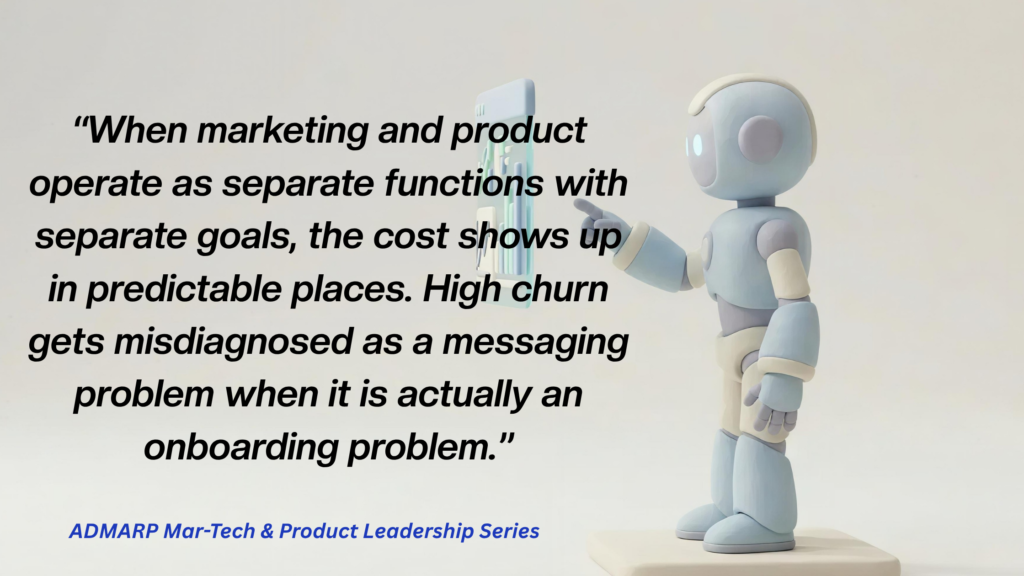
When marketing and product operate as separate functions with separate goals, the cost shows up in predictable places. Acquisition campaigns bring users that the product experience was never designed to retain. High churn gets misdiagnosed as a messaging problem when it is actually an onboarding problem. Marketing invests in brand campaigns that product has not built an experience to support. Product ships features that marketing was never involved in positioning, and then wonders why adoption is slow.
The silo is not just inefficient. It actively undermines both functions. Marketing without product context is working with incomplete information. Product without marketing input is building for a customer it may not fully understand. The organisations that have resolved this tension are not just running more efficient operations. They are growing in ways that their competitors cannot easily reverse-engineer, because the advantage is structural rather than tactical.
What professionals and communities need to pay attention to
The implications for marketing professionals are significant. The skills that defined a strong marketer a decade ago are not sufficient to define a strong marketer today. Understanding product analytics, user behaviour data, onboarding flows, retention mechanics, and growth systems is no longer optional context. It is part of the job.
This does not mean every marketer needs to become a product manager. It means the best marketing professionals in digital environments are the ones who can hold a conversation about activation rates with the same fluency they bring to a brand brief. Who understand what a cohort analysis is telling them and can translate that into a decision about messaging or channel investment. Who sit in product roadmap meetings and add value because they bring the market context that the engineering team does not naturally carry.
For professional communities, associations, and training platforms, the responsibility is equally clear. If the curriculum and the conversations stop at traditional marketing, the community is preparing its members for a version of the profession that is steadily contracting. The growth is happening at the intersection. That is where the content, the convening, and the development needs to be.
The forward-facing position
The marketing function is not disappearing. It is being reintegrated into the systems that drive business outcomes. In some organisations, that reintegration has already happened and the results are visible. In others, the conversation is just beginning.
The professionals who will lead marketing in digital businesses five years from now are already developing fluency in product thinking, data systems, and growth mechanics alongside their core marketing skills. They are not waiting for the industry to catch up to them.
The question for every marketing leader and every professional community is the same: are you building the infrastructure for where the profession is going, or are you still optimising for where it has been?
ADMARP is making a deliberate choice to engage with the intersection. The ecosystem deserves a professional community that reflects how digital businesses actually grow.
Follow ADMARP on Socials via: Instagram