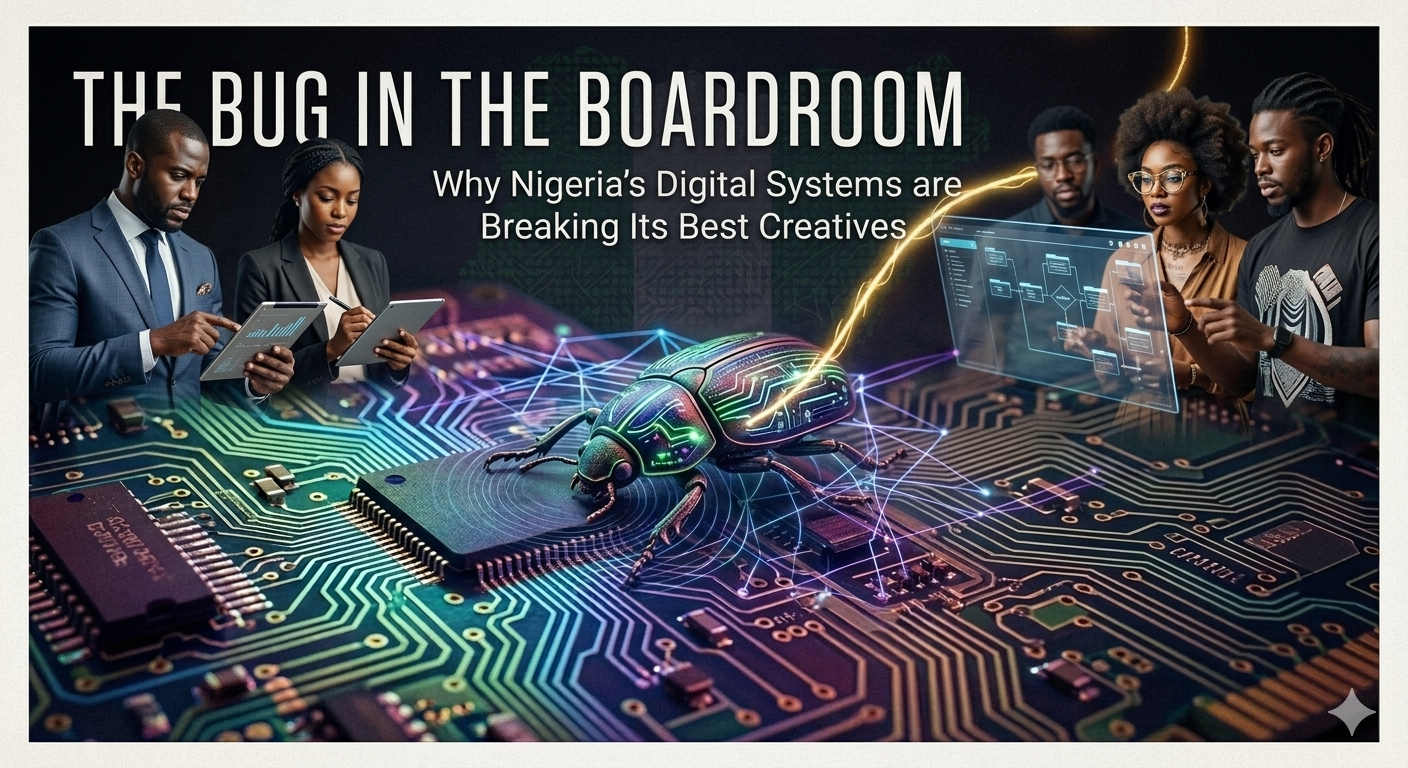

The modern corporation is a masterpiece of efficiency, built on a single, unwavering promise: predictability. We love systems because systems don’t have bad days. Systems don’t get bored. And systems definitely don’t decide to tear down the marketing department to rebuild it as a bioluminescent “idea garden” because they “had a feeling.”
But here’s the glitch: Efficiency is the systemic enemy of the new.
We are currently facing a “Rare Earth” crisis, not of minerals, but of people. We’re obsessed with the “entrepreneurial type,” that hyper-valuable, hyper-rare breed capable of seeing the structure from the outside. Yet, our organizations are built like immune systems, designed to identify, coordinate, and eventually neutralize anyone who operates outside the base code.
If you’re managing someone who fits perfectly into your quarterly evaluative rubric, they aren’t a creative; they’re an optimizer. And in a world being eaten by AI, optimizers are a commodity. It’s the “Weirds” we need: the ones who don’t just fly in a different direction, but in a different dimension entirely.
In the Nigerian digital marketing landscape, this systemic friction has reached a breaking point. As we lean deeper into AI-native discovery and hyper-automated campaign lifecycles, the “creative strategist” has been rebranded as a data-entry clerk with a mood board. We’ve turned the art of persuasion into a “data monitoring maze”.
When every idea must be validated by a real-time ROI scorecard before it even breathes, we aren’t just optimizing; we are suffocating the very “craftsmanship” that ADMARP leaders argue is the heartbeat of world-class storytelling. This constant “always-on” pressure, where short-form content demands are relentless—is the primary fuel for the burnout epidemic sweeping through Lagos agencies.
The problem is fundamental. You cannot evaluate true creativity within a system, because systems are built on precedents. To be creative is to be unprecedented. If a person’s output can be measured by existing KPIs, they aren’t creating; they are fulfilling a brief.
This makes the visionary a “real pain” to manage. They are the friction in your frictionless workflow. They refuse to flock with the “standard feathers” because their value lies precisely in their refusal to align. They don’t want to inhabit your structure; they want to be the architect of the next one.
To survive the 2026 marketing shift toward “intentionality” over “expansion”, we must stop treating burnout like a productivity glitch and start treating it as a structural failure.
For Agency Owners and Managers:
Establish “Input-Based” Goals: Move away from judging creatives solely on volatile output metrics (like lead volume) and start valuing the “input behavior”, the research, the experimentation, and the architectural thinking that leads to the win.
Create Protective Buffers: Build “walled gardens” where your “Weirds” can experiment without the immediate threat of a dashboard metric. Use AI to handle the volume and the mundane, freeing your strategists to focus on the high-impact “human reset”.
For the Creatives and Strategists:
Niche Down Ruthlessly: Stop being a “full-service” generalist. Specialise so deeply in a specific outcome that you become the architect of the solution, not just a cog in the client’s machine.
Protect Your Flow: Reclaim your “weird” by setting rigorous boundaries. Batch your creative tasks to find flow and use your community, like the ADMARP Community, to brainstorm away from the “nerve-cracking” pressure of the brief.
The future of Nigerian digital marketing doesn’t belong to the fastest system, but to the system that knows when to get out of the way of its people.