IT Blog

AI Search
Uncategorized

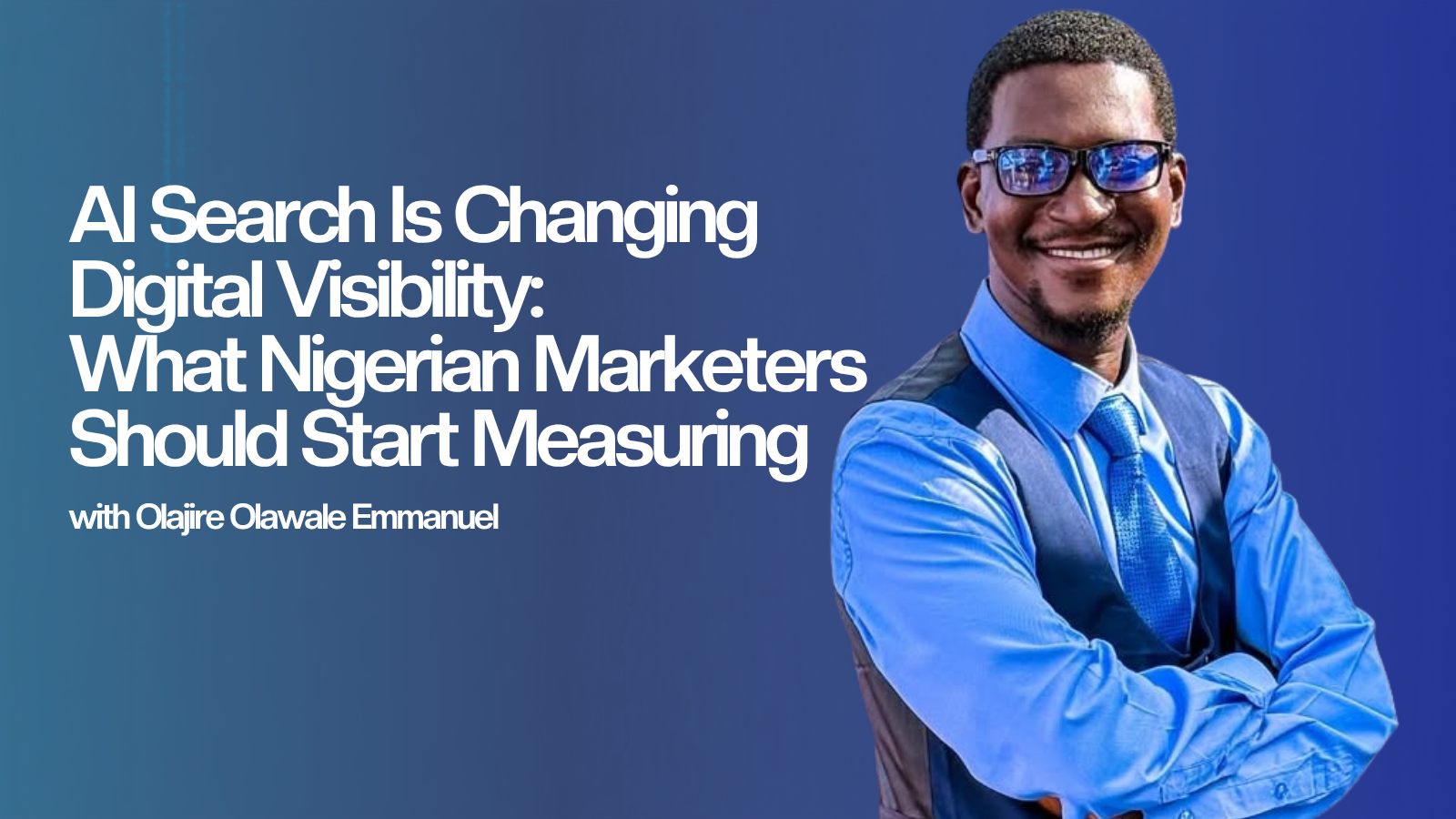
AI Search Is Changing​ Digital Visibility What Nigerian Marketers Should Start Measuring

Search visibility is no longer only about blue links and keyword positions. As AI-powered search experiences increasingly synthesize answers and cite sources, Nigerian marketers need a more disciplined way to measure whether their brands are discoverable, understandable and credible enough to be referenced.

From Search Rankings to AI Visibility

For years, digital visibility had a familiar scoreboard: where does the website rank on Google, how much organic traffic is it generating, which queries are mocing, and how many visits turn into leads or sales? Those questions still matter. But they are no longer the whole conversation.
People increasingly discover information through AI-powered search experiences and assistants. Instead of manually reviewing a page of links, a user can ask a detailed question and receive a synthesised response containing explanations, recommendations and, in some cases, citations to supporting sources.
That creates a new question for marketers: when an AI system answers a question related to your industry, does itknow enough about your brand, expertise or content to mention or cite you For Nigerian marketers, agencies and businesses, this deserves serious attention. Not because SEO is dead. It is not.
And not because somebody has discovered a secret formula for “ranking on ChatGPT.” Claims like that should betreated carefully. The opportunity is to understand how discovery is changing, measure it properly and preparedigital assets accordingly.

SEO Is Not Dead. The Foundation Still Matters

One mistake in discussions around AI search is the assumption that traditional SEO has suddenly become obsolete. Current guidance from major search engines points in the opposite direction. Google states that the same foundational SEO practices relevant to traditional Search remain applicable to its AI features. Pages still need to satisfy the underlying technical requirements for Search. That means the supposedly boring work remains important: crawlability, indexability, readable page content, sensible internal linking, accurate structured data and genuinely useful information.
These fundamentals do not become irrelevant because the interface answering a user’s question uses generative AI. If anything, AI search gives marketers another reason to get them right.

AI Visibility Is Becoming Measurable

Until recently, conversations around visibility inside AI-generated answers relied heavily on manual testing. Marketers entered prompts into an AI system, looked for their brand, took screenshots and repeated the exercise later. That can still be useful for observation, but it has obvious limitations. The measurement environment is now improving. Microsoft introduced AI Performance in Bing Webmaster Tools in 2026, giving publishers visibility into how their content is cited across supported AI experiences. The reporting includes citation activity and cited pages, and Microsoft has expanded the area with additional context around topics, intents and Citation Share.

This matters because marketers are accustomed to measuring rankings and clicks. In AI-generated answers, a different layer of questions becomes relevant: Was the website cited? Which pages were cited? What topics or intents were associated with those citations? Is citation activity changing over time? AI visibility is moving from an abstract marketing conversation toward something publishers can increasingly observe with first-party data.


My Day-Zero Experiment

I recently decided to test this rather than simply speculate about it.
My name is Olajire Olawale Emmanuel, and I work in digital marketing across paid advertising, SEO, lead generation and conversion strategy. I am running a live experiment using my own professional identity and website to investigate a straightforward question:
Can I deliberately improve the discoverability and citation footprint of my professional entity and original content across AI-powered search experiences?
The important part is that I established a baseline before claiming success. At the beginning of the experiment, the AI Performance dashboard available to me in Bing Webmaster Tools showed zero recorded AI citations and zero cited pages. That is not an impressive result. It is a useful baseline. If I only documented the experiment after citations appeared, it would be easy to construct a success story around whatever tactics had recently been implemented. Starting at zero allows me to observe what changes, if anything, as the experiment progresses.

What I Am Actually Testing

The experiment is not based on trying to manipulate an AI model. The first area is technical accessibility. Important pages need to be crawlable and indexable. I have verified the website through webmaster platforms, worked on sitemap discovery and implemented IndexNow so participating search engines can receive updates when content changes.
The second area is identity consistency. My professional name, occupation and areas of expertise should not tell completely different stories across my website and established third-party profiles. Many professionals have years of digital debris behind them: abandoned biographies, outdated CVs, old job titles and different versions of their names. Cleaning this up is not keyword stuffing. It is reducing unnecessary ambiguity.

The third area is original content. Instead of publishing dozens of generic pages targeting every conceivable variation of “digital marketer Nigeria,” I am documenting actual work, observations and experiments. If everyone can generate the same article from the same prompt, publishing more of it does not automatically create authority. The fourth area is independent corroboration. There is a meaningful difference between what I claim about myself on my own website and what credible third parties independently associate with my name. That is one reason an editorial contribution to a professional industry platform carries a different signal from a biography hosted solely on a personal website.
What I Am Not Claiming
This is where marketers need discipline. I cannot currently tell you that adding a particular schema property will make ChatGPT recommend your company. I cannot tell you that publishing a specific number of articles will produce AI citations. I cannot guarantee that a business will “rank number one on ChatGPT.” We should be suspicious of guarantees of that kind. Generative answers can vary according to the question, the system being used, available sources and other factors outside a marketer’s control. Microsoft itself describes Citation Share as an observational metric rather than a ranking system. There is still a great deal to learn. That uncertainty should make us more rigorous, not more promotional.
What Nigerian Marketers Should Start Measuring
Most businesses do not need an entirely new analytics department for AI search. They need to expand the questions they already ask. Continue measuring organic traffic, conversions and traditional search performance, but start recording AI visibility as a separate layer. Where webmaster tools expose AI-specific reporting, establish a baseline. Record citations. Identify which URLs receive them. Watch the topics and intents associated with those citations where such data is available. Look at referral traffic from AI platforms in analytics when it can be identified.
Most importantly, connect visibility to business outcomes.
A large number of citations that produce no meaningful engagement may be less valuable than a small number of highly relevant appearances that send qualified prospects to a business. Marketers should resist replacing one vanity metric with another.
Entity Consistency Deserves More Attention
There is another lesson emerging from the experiment that is particularly relevant to professionals and smaller Nigerian businesses: audit what the internet says about you. Search the business name. Search the founder’s name. Look at old profiles and directory entries. Check whether the website describes the business the same way major professional profiles do.
For an established company, this might involve ensuring that its name, services and official website are represented consistently. For a consultant or professional, it can mean using a stable professional name and maintaining accurate information about what the person actually does.
This is not an argument for creating hundreds of directory listings. That approach can produce more noise than authority. The goal should be clarity and credible corroboration, not sheer volume.
Original Experience May Become More Valuable, Not Less
Generative AI has dramatically reduced the cost of producing average informational content. Anyone can generate a generic article explaining the benefits of Facebook advertising in seconds. That means marketers should think carefully about what they can publish that is not easily commoditized: actual campaign observations, original datasets, experiments, customer research and first-hand expert commentary grounded in work that was genuinely performed. The competitive advantage is not simply producing more words. It is producing information worth retrieving. Google’s guidance for AI features continues to emphasize useful, unique content and the same people-first principles that apply across Search. That is a useful standard regardless of which search or AI platform eventually sends the visitor.
Don’t Build an “AI SEO” Strategy on Hacks
Whenever a new distribution channel appears, a cottage industry of shortcuts follows. AI search is no exception. Marketers will encounter tools claiming to reveal secret AI rankings, guaranteed citation strategies and supposedly mandatory technical files. Some tools will become genuinely useful. Others will simply repackage familiar SEO concepts under new terminology.
The safer approach is to separate what can be demonstrated from what is merely theorized. Use first-party reporting where available. Test hypotheses. Keep records. Compare periods. Document failures as well as successes. Do not confuse correlation with causation. If my website receives its first AI citation tomorrow, that does not automatically prove that the last change I made caused it. That is exactly why longer-term observation matters.
Where Nigerian Businesses Can Start
A Nigerian business does not need to rebuild its entire website because AI search exists. Start with the fundamentals. Make sure important pages can be crawled and indexed. Publish information that answers real customer questions instead of producing content solely because a keyword tool shows search volume. Keep important business information accurate across credible platforms. Create clear pages explaining services, expertise and evidence of work. Use first-party tools such as Google Search Console and Bing Webmaster Tools rather than relying entirely on third-party estimates. Then establish a baseline.
You cannot intelligently discuss improvement if you never recorded where you started.
The Bigger Shift
The most interesting change is not simply that search engines now have generative AI features. The bigger change is in user behaviour. Search is becoming more conversational. Questions can be more detailed. Answers are increasingly synthesized.
Discovery can happen before a user ever visits a traditional results page.
For marketers, this expands the job. We still need to make businesses discoverable. Increasingly, we also need to make their information clear enough to understand, credible enough to reference and valuable enough to deserve inclusion when machines synthesise answers from the web.
I do not yet know exactly where my experiment will end. That is the point. I started with zero recorded AI citations. If that number changes, I want to understand what happened. If it does not change, that result is useful too because it challenges assumptions about which tactics actually influence AI visibility.
The marketers who will understand this shift best will not necessarily be those making the loudest predictions today.
They will be the ones measuring it.

About the Author

Olajire Olawale Emmanuel is a Digital Marketing Strategist and a member of the Association of Digital Marketing Professionals, ADMARP member whose work covers Meta Ads, Google Ads, SEO, lead generation, conversion strategy  and AI-powered marketing.
He is currently documenting a live 
experiment examining how professional entities and web content become discoverable and cited across AI- powered search experiences. Professional website: dmolawale.com.ng 

Leave a Reply

Your email address will not be published. Required fields are marked *