
For years, the search visibility question for Nigerian brands was relatively straightforward: Where do we rank on Google?
That question is no longer enough.
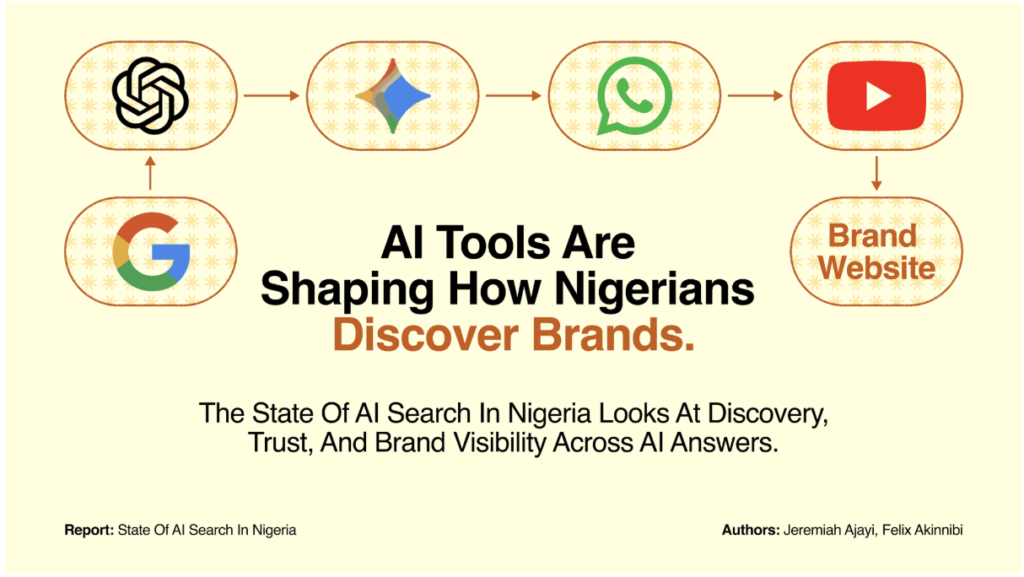
Consumers can now ask ChatGPT which digital bank to use, ask Gemini where to shop online, ask Perplexity where to find an apartment in Lagos, or use Meta AI to compare businesses and sometimes without ever opening a traditional search-results page.
That creates a new competitive question for brands: when AI systems answer questions about your category, does your name come up at all?
In our new State of AI Search in Nigeria report, myself and Jeremiah Ajayi ran a rapid audit across ChatGPT, Gemini, Perplexity and Meta AI to see how these answer engines respond to practical Nigerian consumer questions. We looked at five high-intent sectors — fintech, health/HMO, education, e-commerce and real estate — across two validation runs.
The exercise was directional rather than a nationally representative benchmark. But some patterns were already difficult to ignore.
Some brands are already behaving like early AI defaults
In e-commerce, the answers concentrated heavily around familiar names.
Across the coded sample, Jumia appeared 17 times, Konga 16 times, Jiji 14 times and Slot 11 times. Jumia had an especially strong first-position presence, appearing first in 14 coded responses. More specific prompts brought other brands into the conversation, including Pointek for electronics and PricePally, Chowdeck, Glovo and Supermart.ng for grocery and delivery-related questions.
Real estate was even more concentrated.
Nigeria Property Centre and PropertyPro appeared 14 times each, while Jiji appeared 11 times and Private Property 10 times. Nigeria Property Centre led eight coded responses and PropertyPro led six. No other property brand showed comparable first-position visibility in the sample.
Fintech showed a slightly different pattern.
Kuda, OPay, Moniepoint and PalmPay appeared repeatedly across questions about digital banking, transfers, savings, fees and everyday financial use. Rather than one company completely dominating the category, the AI tools seemed to associate different brands with different use cases.
Kuda was often framed around personal banking and budgeting. OPay appeared around daily transactions and cash access. Moniepoint was associated with POS and business payments, while PalmPay appeared around transfers, rewards and savings. Paystack and Flutterwave became more prominent when the questions shifted toward online checkout and business collections.
This distinction shows that AI visibility may not always create one “winner” in a category. It may create different default brands for different problems.
There is no permanent number-one position
This is where AI search differs sharply from the mental model marketers developed around Google rankings.
Ask the same question twice and the leading recommendation can change.
For the prompt asking which digital bank is best for everyday use in Nigeria, one ChatGPT run selected Kuda, while another selected OPay. A similar shift happened when asking about the best payment app for Nigerian small businesses: one run favoured Paystack, while another favoured Moniepoint.
Neither change necessarily means one answer was correct and the other was wrong. The systems simply emphasised different aspects of the question.
A brand cannot reasonably claim to “rank number one in ChatGPT” because it appeared first in one screenshot. AI answers can change by platform, prompt wording, source mix, use case and repeated run.
The better question is therefore no longer “Where do we rank?”
It is: How consistently do we appear?
AI can also get the local context wrong
The audit exposed another challenge for Nigerian businesses: an AI system can understand that a question is about Nigeria and still recommend options that are poorly suited to the user’s actual context.
Some Nigerian e-commerce prompts surfaced Temu and AliExpress, even where they were not necessarily the strongest fit for a question about reliable local online shopping.
Nigeria-specific housing prompts sometimes returned Booking.com, Rentberry and Flatio. One response even surfaced Eden Life, which was totally irrelevant to the prompt context.
That matters beyond marketing.
If AI tools increasingly mediate product and service discovery, the quality of the public information available about Nigerian companies becomes part of the quality of the answer consumers receive.
What this means for Nigerian brands
In our audit, the brands that surfaced repeatedly were generally those with stronger public evidence around them.
That public evidence can include product pages, media coverage, app listings, regulatory references, customer discussions, reviews, comparison articles, directories and other credible third-party information. The repeated brands in the audit had stronger starting positions than competitors that rarely appeared, although those positions were not guaranteed across every prompt, platform or run.
For marketers, this means the job is expanding.
Google rankings still matter. But brands should also begin tracking the questions people ask about their categories, which competitors AI tools recommend, which sources those systems rely on, whether the brand is described accurately and how often it appears across different tools and repeated prompts.
It also means owned content alone may not be enough.
AI visibility is shaped partly by what the wider web says about a company. Credible third-party mentions, consistent descriptions of what the business does, clear product information, independent comparisons and expert references all give AI systems more public evidence to work with.
This is no longer about being first on Google.
The new battle is about becoming one of the brands that repeatedly comes to mind or, increasingly, comes to the model – when a consumer asks for an answer.
And for Nigerian companies, that competition has already started.
****
Read the full research: Download the State of AI Search in Nigeria report for the complete findings, methodology, sector analysis, and recommendations for Nigerian brands.