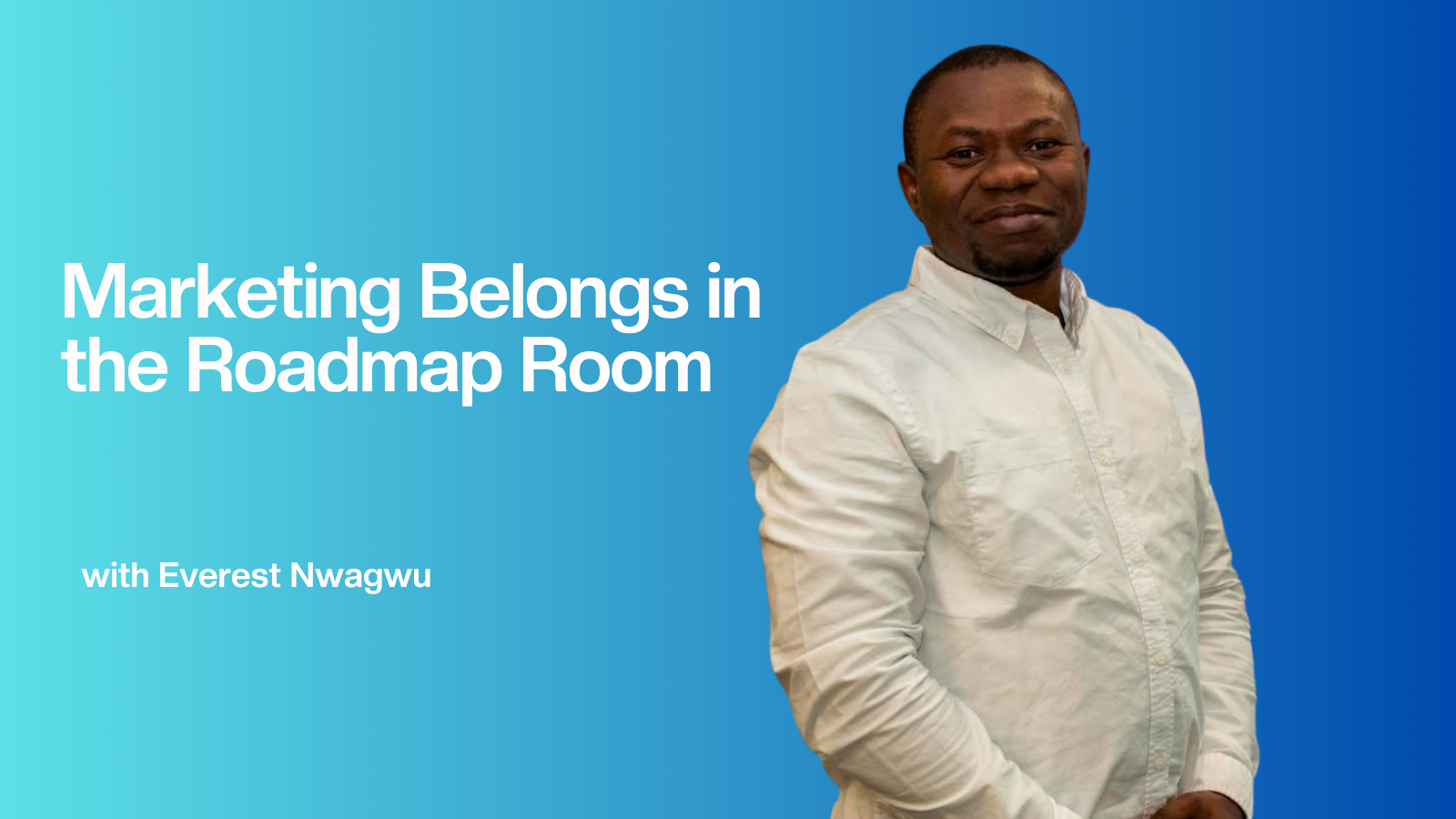

Product Roadmap, what happens when marketing is brought in early.
In many organisations, marketing is still positioned as a downstream function, brought in after the product is defined, built, and nearly ready to launch. The expectation is simple: create awareness, generate demand, and drive adoption. But this model is increasingly outdated, especially in markets where competition is fierce and customer expectations evolve rapidly.

The reality is that the most effective marketing does not start at launch. It starts at conception.
From my experience working across integrated B2B and B2C campaigns in several regions including EMEA, the difference between products that struggle and those that scale often comes down to one thing: whether marketing had a seat in the product roadmap room early enough to influence direction, not just communication.
When marketing is embedded at that stage, the first and most immediate impact is on customer understanding. Marketing teams sit closest to audience behaviour, they see what messages resonate, which channels convert, what objections repeatedly surface, and where engagement drops off. These are not just campaign insights; they are product signals.
When those signals are fed into product discussions, teams stop building in isolation. Instead, they build with context. Features are shaped by real user needs rather than assumptions.
Positioning gaps are identified before they become market problems. The product becomes easier to explain because it was designed with clarity in mind from the start.
This early collaboration also transforms go-to-market strategy. In many cases, marketing teams are forced to “figure out the story” after the product is complete. That often leads to rushed messaging, unclear value propositions, and campaigns that feel disconnected from user reality.
But when marketing is part of the roadmap process, the narrative evolves alongside the product.
Messaging is not an afterthought, it is developed in parallel. By the time the product is ready, the
positioning is already tested, the audience is already defined, and the campaign direction is already aligned with real market insight. Launch becomes execution, not experimentation.
There is also a clear commercial advantage. Misalignment between product and marketing is expensive. It shows up as low adoption rates, poor conversion, increased acquisition costs, and constant rework. When marketing and product operate in silos, teams spend more time correcting mistakes than creating momentum.
Bringing marketing into the roadmap process reduces that friction. It creates a continuous feedback loop where product decisions and market realities inform each other in real time.
Campaign performance can influence feature prioritisation. Customer feedback can shape iteration cycles. The result is a more adaptive, responsive system that learns as it grows.
However, this level of integration requires a shift in how marketing shows up internally. It is not
enough to be seen as the team that executes campaigns or produces content. Marketing has to operate as a strategic partner. That means understanding product constraints, engaging in trade-off discussions, and contributing to decisions that go beyond messaging, into experience, usability, and value delivery.
It also requires confidence. Sitting in the product roadmap room means challenging assumptions, asking difficult questions, and advocating for the customer even when it is uncomfortable. It means moving from “How do we promote this?” to “Should we be building this in the first place?”
At the same time, product teams must be open to that partnership. The most effective collaboration happens when both sides recognise that building a great product and bringing it successfully to market are not separate activities, they are deeply interconnected.
Looking ahead, this integration will become less of a competitive advantage and more of a necessity. As AI accelerates content production and campaign execution, the real differentiator will not be how fast you can market a product, but how well the product aligns with market needs from the beginning.
The organisations that win will be the ones where marketing is not waiting at the end of the roadmap, but helping to shape it from the start. Where insights flow freely between teams.
Where positioning is not retrofitted, but intentionally designed.
Because when marketing sits in the product roadmap room, you do not just launch better
campaigns.
You build better products.
About Author:
When marketing is brought into the product roadmap conversation early, everything changes.
Everest Nwagwu is a data-driven marketing technology expert and strategic leader with over a decade of experience driving growth, digital transformation, and operational excellence across diverse industries.
Armed with an MBA from the University of East London and recognized as a member of the Royal Commonwealth Society, he blends deep academic insights with practical, hands-on business experience. Throughout his dynamic career, he has successfully transitioned through roles as a digital strategist, and senior executive, developing cross-functional expertise that spans financial planning, market development, and organizational leadership.
Everest has consistently built a strong track record of scaling businesses by working with startups, small-to-medium enterprises (SMEs), and large corporate entities across sectors like fintech, healthtech, education, and FMCG. His professional history highlights senior leadership roles, including serving as the Chief Marketing Officer at Zabira Technologies and working as a Product Marketing Manager for Procode Technology. In these positions, he has specialized in blending analytics with digital transformation to execute high-impact customer acquisition, retention, and brand repositioning campaigns.
Dedicated to maximizing return on investment (ROI), Everest frequently champions the integration of predictive analytics and artificial intelligence to optimize user journeys. Beyond his corporate achievements, he is a respected industry speaker, author, and mentor who regularly shares actionable insights on marketing innovation at prominent events like brightonSEO.
He remains focused on empowering entrepreneurs, helping brands grow smarter, and guiding business teams toward long-term sustainability and strategic clarity.
READ MORE ON ADMARP Mar-Tech & Product Leadership Series.
Follow more on ADMARP LINKEDIN